When a tooth is damaged by decay, trauma, or a large filling, there are several ways to restore and strengthen the tooth. Two commonly used options are the inlay/onlay and the crown. In this blog post, I will explain what an inlay/onlay is, why it is often a better alternative than a crown, and in which situations a crown might be preferred.
What is an inlay/onlay?
An inlay and an onlay are dental restorations used to repair and strengthen a damaged tooth without needing to cover the entire tooth as with a crown. They are made from lithiumdisilicate, a very strong and durable ceramic material known for its excellent aesthetics and long-lasting performance.
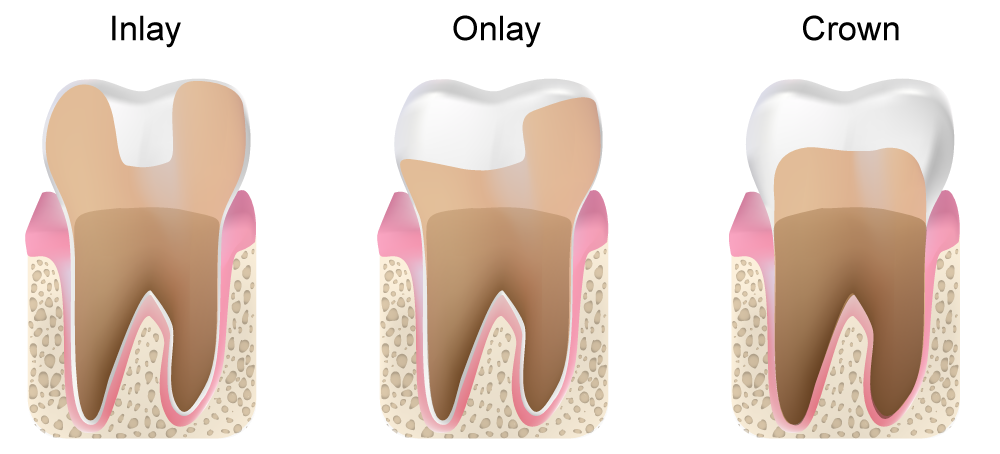
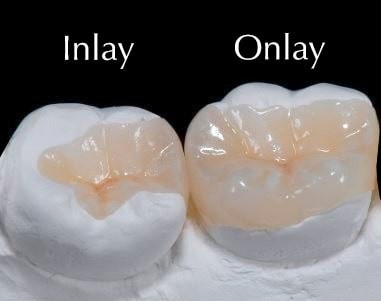
– Inlay: An inlay fills the area inside the tooth’s cusps, similar to a filling, but much stronger and more precise.
– Onlay: An onlay covers one or more of the tooth’s cusps and may even cover part of the outside of the tooth. It is ideal for more extensive damage, while still preserving the healthy tooth structure.
Benefits of an inlay/onlay over a crown
1. Preservation of healthy tooth structure: One of the biggest advantages of an inlay/onlay is that less healthy tooth tissue needs to be removed. With a crown, the entire tooth must be shaved down to make space, while with an inlay/onlay only the damaged part is removed. This means more of your natural tooth is preserved.
2. Stronger than fillings: Inlays and onlays are much stronger and more durable than traditional fillings. They provide more support and last longer, which is important for molars that endure significant chewing forces.
3. Aesthetics: Inlays and onlays can be made from tooth-colored materials that seamlessly blend with the rest of your teeth. This ensures a natural and aesthetic result.
4. Durability: With good oral hygiene, inlays and onlays can last for many years. They are less prone to wear than fillings and can better protect the tooth from further damage or decay.
5. Less invasive: Since a crown requires more tooth reduction, an inlay/onlay is a much less invasive treatment.
When is a crown better?
While an inlay/onlay is preferred in many cases, there is one situation where a crown might be better: for aesthetic reasons on the buccal (outer) wall of molars, such as when there is discoloration. In these cases, a crown can provide a more uniform and aesthetically pleasing solution, especially if the tooth is visible when smiling or speaking.
Conclusion
Inlays and onlays are strong, durable, and less invasive options for restoring teeth, allowing more of your natural tooth to be preserved compared to a crown. While crowns can be useful in specific cases, such as significant discoloration on the outside of molars, an inlay or onlay is often the best choice for maintaining both your tooth’s health and aesthetics.
Interested in finding out if an inlay/onlay is right for you? Contact me for a consultation!