
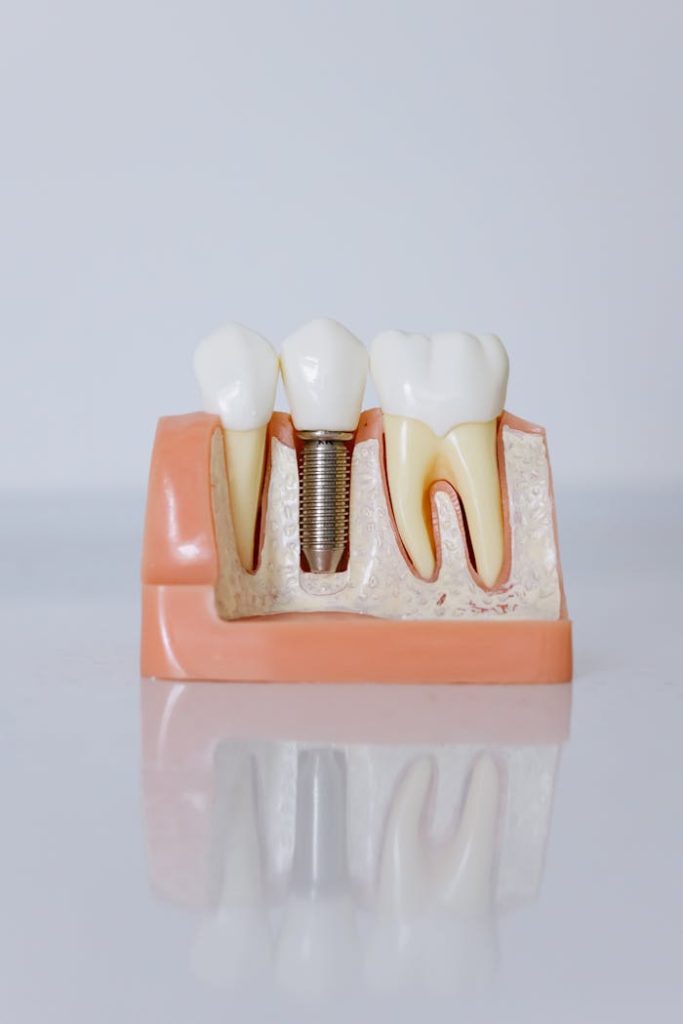
A healthy set of teeth is essential for your overall well-being, and missing one or more molars can not only affect your chewing function but also your self-confidence. Fortunately, there are effective solutions to fill these gaps, such as implants and bridges. In this blog post, I´ll explain you what these treatments entail, their pros and cons, and help you make the best choice for your situation.
WHAT ARE IMPLANTS?
Implants are “artificial roots” that are placed in the jaw to replace a missing tooth or molar. They are usually made of titanium and are surgically implanted into the jawbone. After a healing period, during which the implant fuses with the bone, a crown is placed on the implant to replace the missing tooth.
Advantages of Implants:
1. Natural Appearance: Implants are custom-made and resemble your natural teeth, making them aesthetically pleasing.
2. Durability: With good oral hygiene, implants can last many years, sometimes even a lifetime.
3. Preservation of Jawbone: Placing an implant stimulates the jawbone, helping to prevent bone loss.
4. No Damage to Surrounding Teeth: It is not necessary to grind down neighbouring teeth when placing an implant.
Disadvantages of Implants:
1. Cost: Implants are often more expensive than bridges and are not always covered by insurance.
2. Duration: The process of placing an implant can take longer, including healing time and fitting the crown.
3. Surgical Procedure: The placement of an implant requires a surgical procedure.
WHAT ARE BRIDGES?
A bridge is a dental restoration used to fill a gap where one or more teeth are missing. A bridge consists of two or more crowns placed on the surrounding teeth, with an artificial tooth (or teeth) in between to fill the open space.
Advantages of Bridges:
1. Quick Solution: Placing a bridge can be faster than placing an implant, often completed in one or two visits.
2. Cost: Bridges are generally cheaper than implants and may be better covered by insurance in some cases.
3. No Surgical Procedure: The placement of a bridge does not require surgery, making the process less invasive.
Disadvantages of Bridges:
1. Damage to Surrounding Teeth: To place a bridge, surrounding teeth must be ground down to make space for the crowns, which can weaken their structure.
2. Risk of Nerve Problems: A bridge can be a good option if the surrounding elements have had good root canal treatments and need a crown for reinforcement. However, if you place a bridge on a pillar that has not undergone endodontic treatment, there is a chance that the nerve may become problematic. This could lead to the need for a root canal treatment, which would require drilling a hole in the bridge.
3. Loss of Multiple Elements: If a pillar in a bridge needs to be removed for any reason, you would lose not just one, but two elements.
WHAT IS THE BEST CHOICE FOR YOU?
The choice between implants and bridges depends on several factors, including your oral health, budget, and personal preferences.
– Implants are ideal if you want to preserve the surrounding teeth and prefer a durable solution that promotes the health of your jawbone.
– Bridges are a good option if the surrounding elements have had good root canal treatments and need a crown. However, be aware of the risk of loss of multiple elements if one of the pillars fails.
It is always important to consult with your dentist to determine which option is best for your specific situation. Together, you can weigh the pros and cons and choose the best solution for your teeth.
Do you have questions about implants or bridges? Contact me for a consultation!